
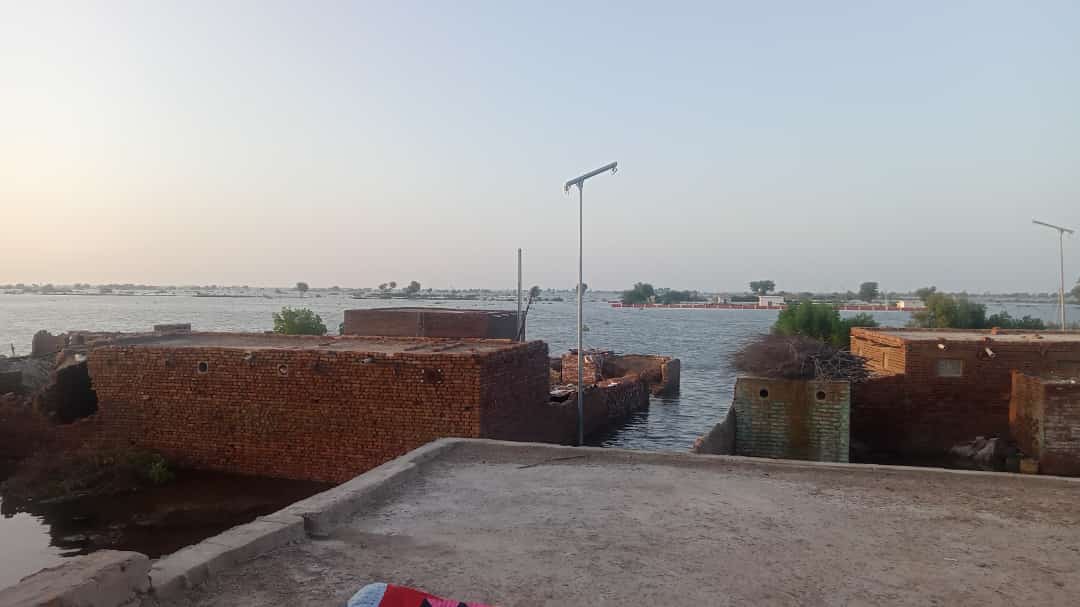
Floodwater surrounds buildings in Umeed Ali Junejo village, Qambar Shahdadkot district, Sindh, during the 2022 floods. Source: Ali Hyder Junejo
When floods destroy a bridge, rebuilding it is urgent. But if the replacement is just as vulnerable to the next flood, has development finance delivered recovery or merely postponed another disaster?
Pakistan’s 2022 floods brought that question into focus. The disaster affected 33 million people and caused approximately US$14.9 billion in damage and US$15.2 billion in economic losses, according to a joint post-disaster assessment. Behind those figures were damaged homes, interrupted schooling, lost livelihoods and communities facing an uncertain recovery.
International development finance can help Pakistan prepare for future shocks. But its success should be judged by more than how much money is approved or how quickly damaged infrastructure is rebuilt. The test is whether financing reduces vulnerability before the next emergency.
For the World Bank and Pakistani authorities, that means combining recovery support with sustained investment in preparedness, working with accountable local institutions and designing infrastructure for changing climate risks.
The price of preparing too late
The scale of Pakistan’s financing challenge is enormous. The World Bank’s 2022 Country Climate and Development Report estimated that the country would need approximately US$348 billion between 2023 and 2030 for a comprehensive climate and development response. That included around US$152 billion for adaptation and resilience and US$196 billion for deep decarbonization, meaning substantial reductions in greenhouse-gas emissions across the economy.
These are estimated investment needs, not World Bank funding commitments. The distinction matters: identifying what Pakistan needs does not establish where the money will come from, how affordable it will be or which institutions can deliver results.
Nor should the figures obscure a practical question. What makes a community safer: reconstruction after a flood, or reliable drainage, accessible shelters, functioning warning systems and public facilities built to withstand foreseeable hazards?
Pakistan needs both recovery and prevention. Families cannot wait for long-term reforms while their homes remain damaged. Yet reconstruction should reduce future losses rather than recreate the conditions that made the disaster so destructive.
Recovery can build resilience
World Bank support following the floods illustrates both the importance and complexity of recovery finance.
In December 2022, the Bank approved US$1.692 billion for five projects in flood-affected Sindh. They were separate operations with different purposes, not one reconstruction programme.
The US$500 million Sindh Flood Emergency Rehabilitation Project was designed to benefit at least two million people through infrastructure restoration and more resilient rebuilding. A separate US$500 million housing project aimed to support grants for 350,000 housing units. These were stated project targets, not evidence that all the intended outcomes had already been achieved.
Such commitments show why it would be misleading to dismiss all post-disaster finance as short-sighted. Rebuilding can improve protection, restore essential services and make housing safer. Recovery and resilience need not compete.
The harder problem is ensuring preparedness receives sustained funding when no disaster dominates the headlines. A warning network needs maintenance, trained staff and public trust before an emergency. Drainage systems require routine upkeep, not just announcements after streets flood. Development finance should support those less visible tasks as seriously as construction.
Money needs institutions that can deliver
Financing cannot reduce vulnerability on its own. It passes through institutions that select projects, procure materials, oversee construction and maintain completed facilities.
Pakistan’s National Adaptation Plan sets out priorities for adapting to climate risks. But a national plan cannot substitute for clear responsibilities and implementation. The division of authority matters. Under the Eighteenth Amendment to Pakistan’s Constitution (2010), much environmental policymaking falls within provincial responsibility. Provinces, in turn, must make local implementation possible. Article 140A of the Constitution requires them to establish local government systems and devolve political, administrative and financial authority to elected local representatives.
For climate adaptation, this means district and municipal institutions should not be expected to deliver resilience without predictable resources and clearly assigned roles.
Decentralization alone will not solve the problem. Local institutions can face weak oversight, unequal influence and limited technical capacity. Funding closer to communities therefore needs transparent procurement, public reporting, independent checks and ways for residents to challenge decisions.
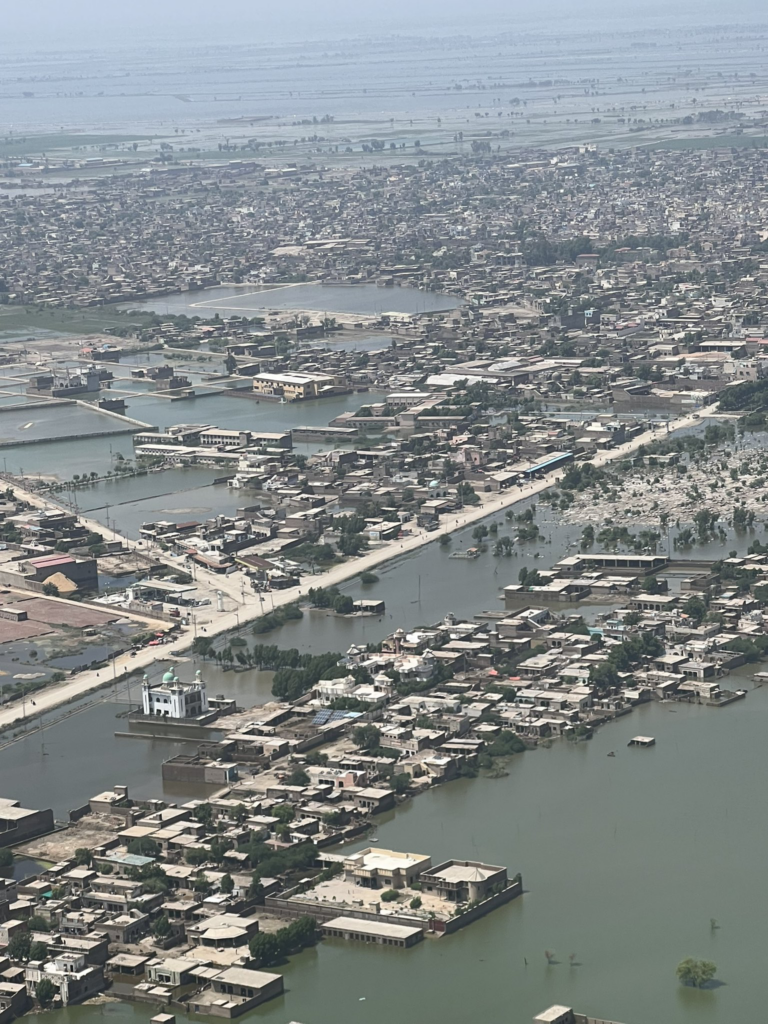
An aerial view of neighborhoods surrounded by floodwater in Sindh, Pakistan, during the 2022 monsoon floods. Source: Ali Hyder Junejo
Three changes to make finance work better
1. Fund preparedness before emergencies
The World Bank and Pakistani authorities should expand investment in forecasting, early-warning communication, evacuation planning and protection of essential public services.
Warnings must reach people in a form they understand and can act on. A forecast has limited value if families lack transport, accessible shelters or confidence that leaving home will protect their livelihoods.
Financing instruments must also match their purpose. Pre-arranged emergency credit, insurance payouts and anticipatory cash transfers are not interchangeable: their triggers, costs and repayment obligations differ. Pakistan should choose them according to the risks they address rather than assume that every instrument can release funds before a disaster.
2. Give local institutions funding and support
Provincial authorities and development partners should provide multi-year adaptation funding to capable district and municipal institutions, with allocations informed by exposure, poverty and infrastructure needs.
Funding should cover project preparation and maintenance as well as construction. Local teams may need engineering advice, procurement support and assistance assessing climate risks.
The Asian Development Bank’s Climate and Disaster Resilience Enhancement Program connects stronger institutional capacity with investment in resilience and disaster-risk financing. Its approach recognises that financing and the ability to implement projects must develop together.
Community participation should begin before projects are selected. Residents can identify recurring drainage failures, inaccessible shelters and water shortages that a distant planning process may overlook.
3. Measure protection, not just expenditure
Development partners should require climate-risk assessments and suitable resilience standards for the infrastructure they finance. Maintenance responsibilities and funding should be agreed before construction begins.
Nature-based options, including mangrove restoration and floodplain rehabilitation, should be assessed alongside engineered defences rather than assumed to be universally better or treated as decorative additions.
Results should be measured through outcomes. Are essential services less disrupted? Can vulnerable residents reach shelter? Are completed facilities maintained? Publishing these findings would tell citizens more than a list of approved projects and disbursed funds.
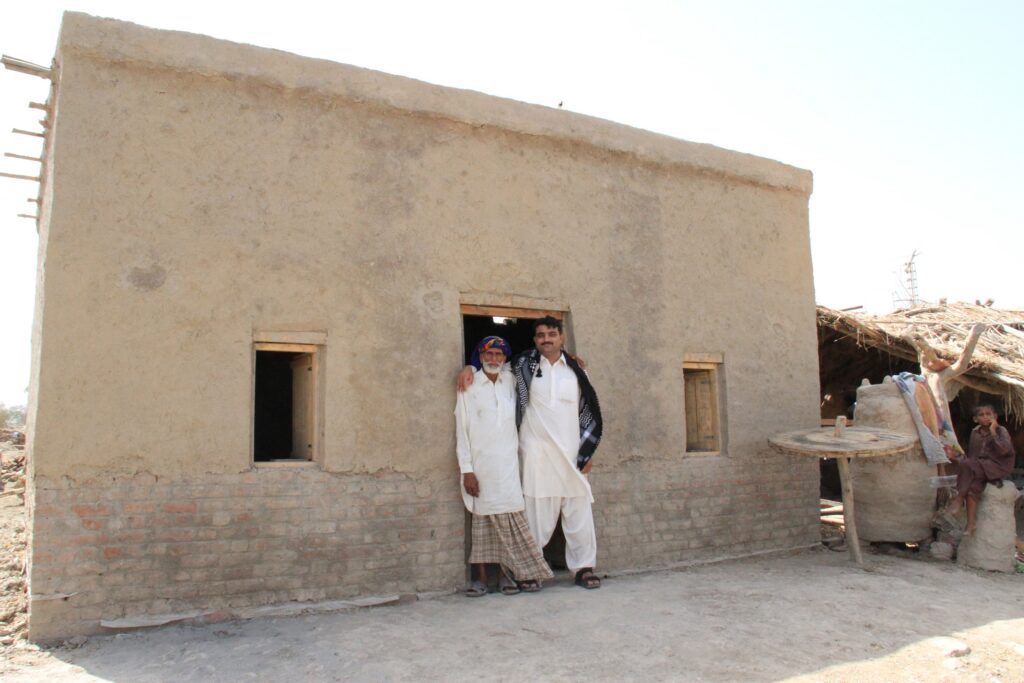
A newly constructed flood-resistant house in Sindh, Pakistan, in June 2011, following the country’s 2010 floods. Source: Vicki Francis
A test beyond Pakistan
Pakistan’s experience raises a broader question for climate-vulnerable countries: can international development finance protect progress rather than repeatedly replace what disasters destroy?
The answer depends on how external financing works with domestic institutions. International lenders can provide funds, technical support and standards. Pakistani authorities must establish clear responsibilities, credible oversight and sustained implementation.
More money matters. But lasting resilience requires financing that arrives at the right time, reaches accountable institutions and keeps supporting communities after construction teams leave.
The aim should not simply be to rebuild the bridge. It should be to make the next flood less devastating for the people who depend on it.

- Beyond Recovery: Can Development Finance Build a Climate-Resilient Pakistan? - November 27, 2026