
As the war in Ukraine persists, South Korea has emerged as Europe’s “backdoor” armory, with Poland serving as its primary strategic gateway. This shift represents more than a series of lucrative transactions; it is a fundamental realignment of the European defense landscape. By moving beyond mere sales to deep industrial integration, Seoul is challenging established European procurement norms and offering a new model for strategic autonomy that balances rapid rearmament with technological sovereignty.
While the Yoon Suk-yeol administration’s “no-lethal-aid-to-Ukraine” policy remains a delicate diplomatic tightrope, the massive transfers of K2 tanks and K9 howitzers are actively reshaping NATO’s eastern flank. This presence raises a critical question: is the South Korean footprint a permanent fixture of European defense, or merely a temporary gap-fill while Brussels struggles to wake its own industrial base?
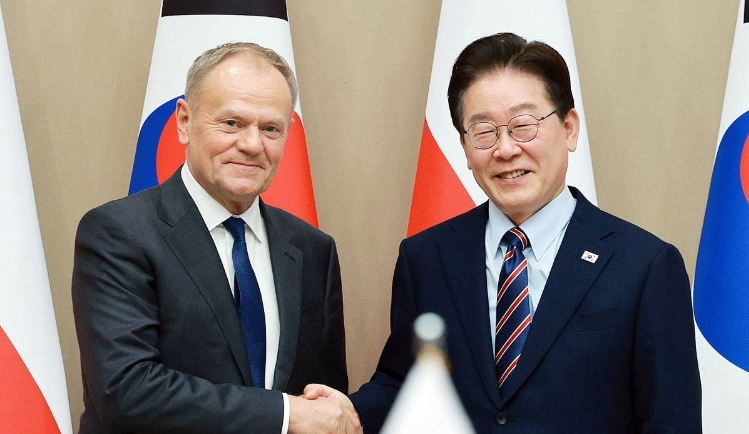 President Lee Jae Myung (Right) and Polish Prime Minister Donald Tusk (Left) pose for a photo during their summit at the Blue House in Seoul, April 13, 2026 | Yonhap
Polish Gateway
The scale and velocity of the ROK-Poland defense partnership since 2022 have no modern precedent in European procurement. The initial framework included 180 K2 black panther tanks, 212 K9 thunder howitzers, 48 FA-50 fighting eagles and 288 K239 Chunmoo MLRS, which combined produced a cost of over 40 billion dollars. Within a four-year framework, Warsaw and Seoul have solidified a strategic axis that transforms Poland into the primary European hub for South Korean defense technology. Following the 2026 Seoul Summit, Prime Minister Donald Tusk and President Lee Jae Myung finalized a financial framework that unlocks the localized production of K2 Black Panther tanks.
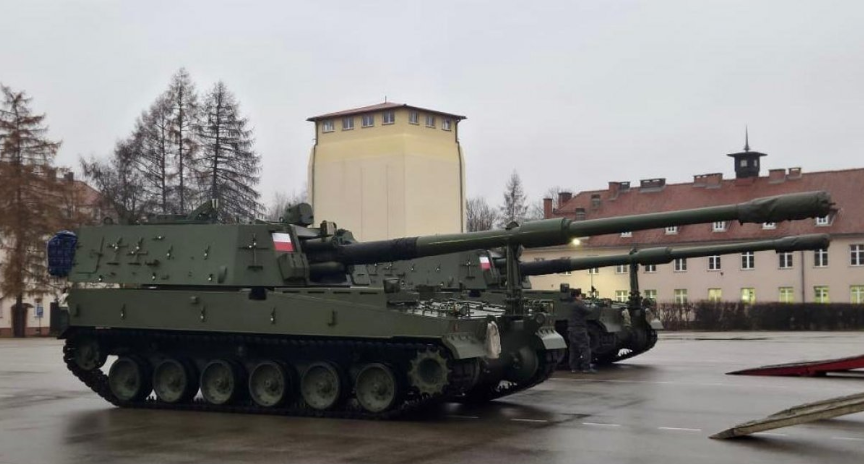
The K9 self-propelled howitzer of the Polish Army / Photo credit: Pawel Bejda | Defense Express
The “Polish Gateway” is characterized by an urgency that Western suppliers have struggled to match. While traditional German or French procurement cycles often span decades, South Korean firms like Hyundai Rotem and Hanwha Aerospace delivered initial batches of K2s and K9s to Polish soil within months of contract signing. By 2026, the partnership has matured into a multi-domain cooperation, including the inauguration of a massive Service & Maintenance Hub in Poznań and plans for joint R&D in AI and semiconductors. This rapid influx of hard metal has allowed Poland to modernize its forces at a pace that its Western neighbors are still only projecting in white papers.
Model Clash
The sudden dominance of “K-Defense” in Eastern Europe has triggered a model clash between two divergent industrial philosophies. On one side is the European model: high-tech, highly customized, but limited by low-volume production and a lack of “hot” assembly lines. On the other is the ROK’s “rapid-scale” manufacturing model, born from a 70-year perpetual state of readiness against North Korea.
South Korean firms offer a unique value proposition: price competitiveness, rapid delivery, and an aggressive willingness to share intellectual property. As noted by the Pulaski Foundation, ROK enterprises are filling a critical gap between the immediate security demands of Central and Eastern Europe and the slow-to-ramp-up capacity of Western European firms. The ROK model treats defense manufacturing like a consumer electronics cycle—constantly iterating, scaling, and exporting—which stands in stark contrast to the boutique approach of the European Defense Technological and Industrial Base (EDTIB).
Diplomatic Tightrope
Seoul’s role in European security is complicated by its “no-lethal-aid” policy, a stance that has evolved into a sophisticated form of “indirect support” via backfills. The Yoon administration has navigated this by becoming a primary node in the transatlantic ammunition pipeline. By lending or selling hundreds of thousands of 155mm shells to the United States, South Korea allows Washington to send its own stocks to Kyiv without compromising American global readiness.
This Global Pivotal State diplomacy has significantly altered Seoul’s leverage within the ROK-US-EU security triangle. While Brussels occasionally expresses frustration with Seoul’s reluctance to provide direct lethal aid, it remains quietly tolerant because the ROK’s industrial output is essential for the collective defense of the continent. By participating in initiatives like the PURL (The Prioritised Ukraine Requirements List) mechanism, Seoul demonstrates solidarity with NATO without crossing the legal rubicon that would risk a direct diplomatic rupture with Moscow.
Industrial Integration
Perhaps the most lasting impact of this pivot is the deep embedding of South Korean industry into the European supply chain. Unlike some Western suppliers that treat technology as a closely guarded secret, South Korea has leaned into localization as a market-entry strategy. The K2PL program is the hallmark of this approach, with Polish state firm Bumar-Łabędy set to begin domestic assembly of dozens of tanks starting in 2027.
This integration provides Eastern European nations with a generational leap in industrial capacity. For Poland, manufacturing the K2PL represents the first time in nearly two decades that the country will produce tanks domestically. This shift moves the ROK-Europe relationship from a simple buyer-seller dynamic to a collaborative ecosystem. By sharing the “keys to the kingdom”—the manufacturing blueprints and maintenance rights—South Korea is ensuring that its defense footprint in Europe will remain relevant long after the immediate crisis in Ukraine has subsided. The “Arsenal of the East” is no longer just shipping weapons; it is building the factories that will define European security for the next thirty years.

- The Arsenal of the East: South Korea’s Defense Pivot to Europe - July 17, 2026