
In recent years, Artificial Intelligence has emerged as the defining force of our time, fundamentally reordering human society in real-time. Since the 2022 arrival of ChatGPT and the subsequent rise of similar Large Language Models (LLMs) like Gemini and Claude, AI has evolved into an essential utility embedded in the core of everyday life. Its reach now spans from creative content to automated business operations, continuously redefining what is technologically possible. Yet, the stakes have shifted as this rapid evolution pushes beyond commercial boundaries. As these AI systems become integrated into national defense and critical infrastructure, they are no longer just software, but an increasingly essential part of how modern states operate, introducing new vulnerabilities for countries that depend on foreign-controlled technologies.
This deepening integration has elevated AI to a top-tier priority for governments worldwide, now treated as a strategic resource on par with energy or telecommunications. Consequently, a global shift toward “sovereign AI” is underway, as nations move to reduce their dependence on the U.S.-China duopoly and prevent a critical reliance on foreign-controlled technologies. Nations like France and Saudi Arabia are already committing tens of billions of dollars to build domestic AI capabilities, a strategy South Korea formalized with its ‘National Sovereign AI Initiative’ last year. Compared to the leading AI powers, however, it has so far struggled to keep pace, yet the initiative reflects Seoul’s growing urgency to close the gap and raises a fundamental question: in a race where scale seems to decide everything, can South Korea compete, and how? To answer this question, it is first necessary to understand how the global AI race is structured and what determines leadership within it.
Who Leads the AI Race and Why?
While LLMs like ChatGPT are the most visible drivers of the current AI boom, they merely represent the ‘intelligence layer’ of a much deeper architecture. Much like a complex assembly line, the final output of these systems depends on a vertically integrated ecosystem, the AI stack. This hierarchy comprises several critical layers: massive high-quality datasets, specialized semiconductors, data centers, cloud infrastructure, and increasingly, the vast energy reserves required to power them. Control over these foundational layers largely determines the winners of the global AI race. At present, the United States holds a dominant position across most of these layers. American firms command nearly every strategic level, from NVIDIA’s near-monopoly on the high-end chips used for AI processing to the cloud infrastructure dominance of Amazon, Microsoft, and Google. This hardware and infrastructure lead is complemented by the models of OpenAI, Anthropic, and Meta, which continue to push the boundaries of model development and performance.
China has emerged as the primary challenger, drawing global attention with the release of DeepSeek, a model that rivaled ChatGPT despite China’s limited access to high-end hardware due to U.S. export controls. Much like its rival, China is aggressively constructing its own AI stack, fueled by large domestic datasets, a deep talent pool and strong government backing. In contrast to the market-led model of the United States, China’s strategy follows a state-led approach, channeling massive national investment to build domestic semiconductor capabilities alongside provincial and local funding for general AI development. This focus on the hardware layer is a strategic response to U.S. trade restrictions, which have made domestic chip production a top strategic priority. Even so, persistent gaps in semiconductor technology continue to limit Beijing’s ability to match the raw computing power of the United States. Consequently, a strategic divide has appeared: while the United States leads in developing more powerful AI models, China is prioritizing rapid diffusion, leveraging cost-efficient designs to embed AI across its vast industrial base. For Seoul, the challenge is not just about keeping up, but about finding a unique way for a mid-sized power like South Korea to carve out its own space in the global AI race.
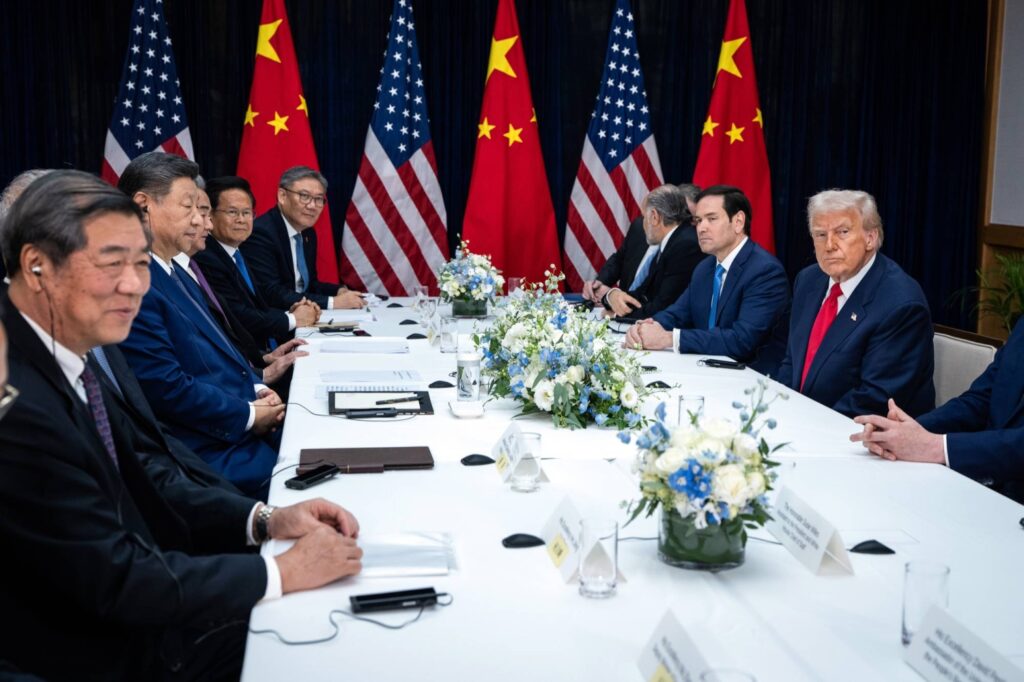 U.S. and Chinese officials meet for high-level talks (Source: Japan Times)
The National Initiative: Seoul’s Bid for Autonomy
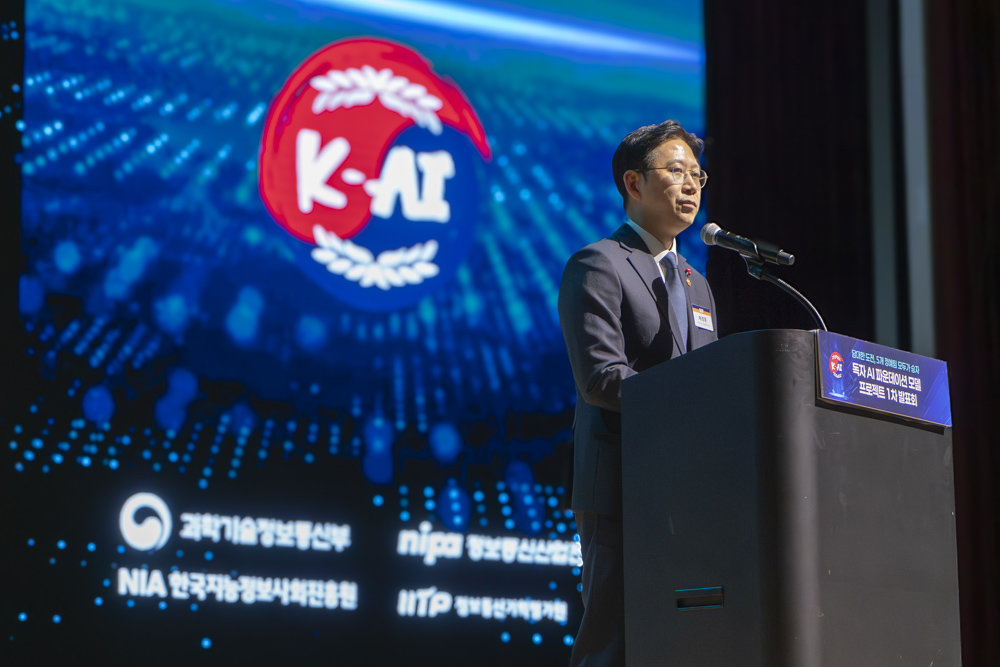
In response to this growing dominance, South Korea is positioning itself as a potential third pillar in the global AI landscape. This ambition is being actively pursued under President Lee Jae-myung, who claims “top-three” status for the nation, a goal closely tied to the government’s National Sovereign AI Initiative launched in 2025. The initiative marked the beginning of a state-led effort to develop globally competitive AI systems by bringing together leading domestic firms and research institutions. Initially, five teams led by players such as Naver Cloud, SK Telecom, and LG AI Research were selected to compete in developing large-scale AI models with government support, including access to large-scale computing resources, high-quality Korean datasets, and funding to both attract and develop AI talent. The objective is clear: to produce one or two globally competitive AI models reaching approximately 95% of leading global performance by 2027. These models are intended to serve as the foundation for broader domestic adoption, including open-source releases to encourage innovation and new applications.
The competition intensified in early 2026. The first round of evaluations narrowed the field, with only three teams advancing while two others were eliminated based on performance and originality. The remaining contenders, including LG AI Research, SK Telecom, and Upstage, alongside a newly added team from Motif Technologies, are now expanding their capabilities through strategic partnerships with firms that complement their strengths, rather than building every component themselves. A clear example is LG AI Research’s EXAONE model, supported by infrastructure specialist Elice through cloud hosting and secure data management, enabling enterprise-scale deployment. Through such collaborations, Korea is effectively assembling an integrated AI stack within its own ecosystem, linking model development directly to real-world application. At its core, these efforts show that the initiative extends beyond building models to both strengthening domestic control over key parts of the AI stack and creating the conditions needed to integrate AI across the economy.
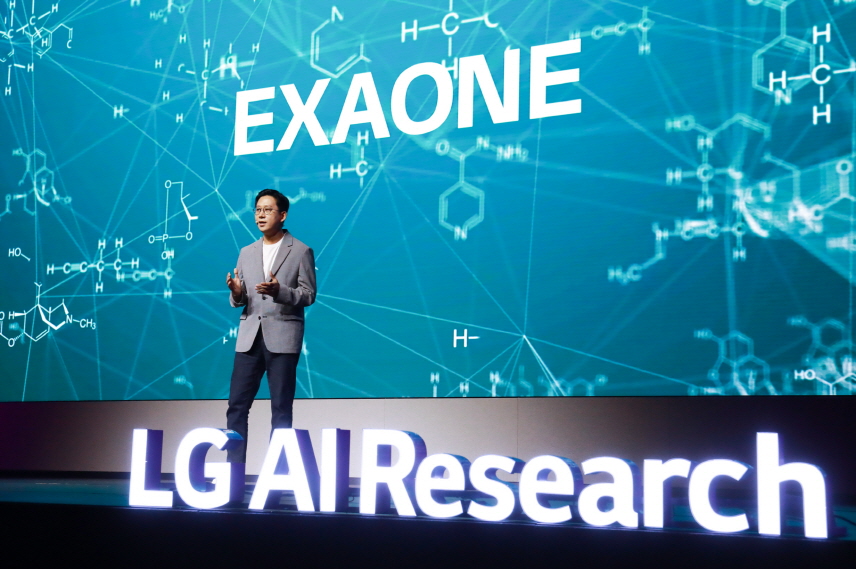 LG AI Research presents EXAONE (Source: LG)
Korea’s Strategic Opening
Rather than competing on the same terms as the two superpowers, South Korea occupies a distinct position in the global AI race. It cannot match the United States in developing advanced AI models or China in massive industrial scale, but it sits between the two, combining elements of both. While U.S. firms lead in high-performance processing chips, they remain dependent on specialized memory, a segment dominated by Korea. As a leading producer of High Bandwidth Memory and next-generation batteries, Korea supplies critical components that underpin both the computation and energy requirements of physical AI systems. Building on this foundation, the National Sovereign AI Initiative may find its most defensible opening in physical AI, a transition from the “stationary brain” of software confined to data centers to intelligence integrated into the physical world. The core of this shift is integration: by linking models with sensors, semiconductors, and robotics, AI moves beyond processing data to operating directly within real environments. Machines are no longer limited to pre-programmed instructions, but can perceive, respond to, and adapt within the systems they inhabit. This aligns closely with South Korea’s industrial structure. With strong capabilities in semiconductors, automotive manufacturing, shipbuilding, and advanced machinery, Korea provides both the infrastructure and real-world environments needed to deploy physical AI at scale, positioning it as an ideal testing ground for moving complex AI into practical operation.
This shift is already visible in practice. At CES 2026, one of the world’s most influential technology exhibitions, Korean firms accounted for a significant share of innovation awards, highlighting their growing impact in applied AI and robotics. One example is LG’s CLOiD, an AI-powered home robot designed to coordinate household tasks by controlling connected appliances, illustrating how AI is increasingly embedded in everyday environments. Collaborations under the national initiative point in the same direction. Upstage’s AI model is being paired with HyperAccel’s inference chips to reduce deployment costs, while robotics startup RLWRLD is embedding these systems into operational settings such as hotels and logistics facilities.
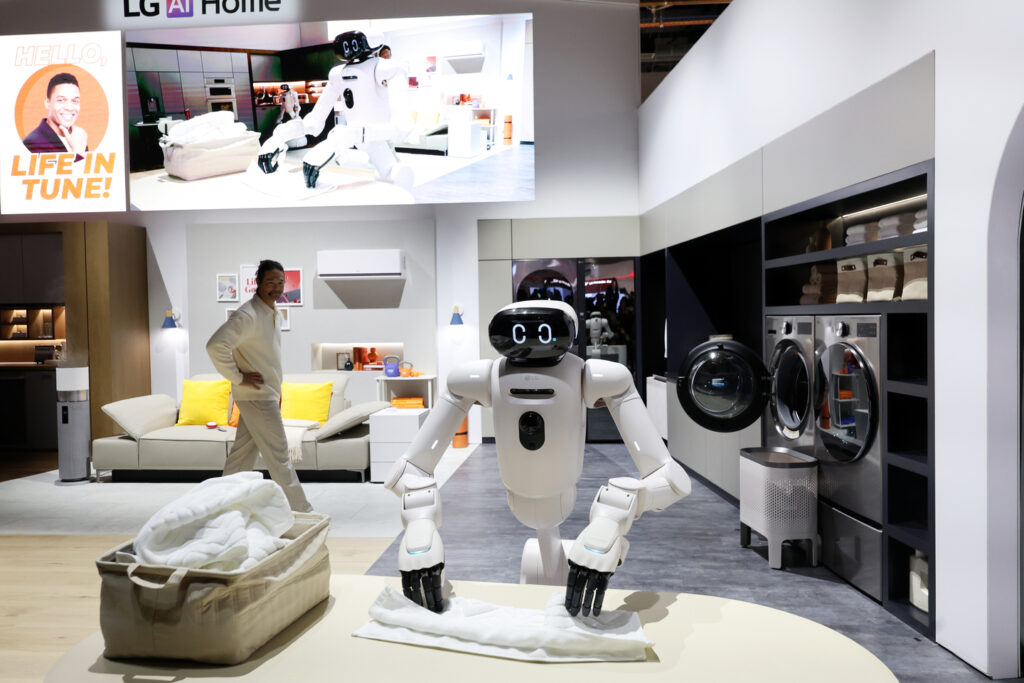 LG showcases its CLOiD home robot at CES (Source: Korea JoongAng Daily)
A Race Against Time and Talent
For most countries, catching up directly with the United States and China remains extremely difficult given the scale of resources required. The Korean approach suggests a different path: not competing head-on in model scale, but redefining the terms of competition by leveraging its industrial strengths to secure a critical role in the global AI value chain. As AI continues to move beyond software into physical systems, this shift also reshapes the balance of dependence, positioning Korea as a critical supplier of the hardware that enables real-world AI systems. If successful, its role may not be to lead in raw intelligence, but in how that intelligence is applied, a domain where few nations possess the necessary industrial foundation to compete. However, this position is far from secure. While Korea currently leads in specialized memory, the gap is narrowing as China pushes aggressively into advanced memory with heavy state support, while U.S.-based Micron is also expanding production and investment to strengthen its position.
At the same time, Korea faces a deeper structural challenge: talent. As China and the United States channel thousands of top engineers into AI and semiconductor development, South Korea is increasingly constrained by a domestic shortage of specialized labor. More importantly, the shift toward physical AI is also transforming the nature of work itself. While routine and repetitive tasks are increasingly automated, industrial demand is pivoting toward new types of roles such as AI trainers and operators responsible for overseeing automated processes. This raises a more fundamental issue: not only attracting talent, but developing a workforce capable of working alongside increasingly intelligent machines. Ultimately, the country’s future in the AI race will depend as much on its ability to build the world’s most advanced systems as its ability to retain the minds capable of building and deploying them. While challenges remain in attracting and retaining this talent domestically, the country clearly possesses the building blocks needed to emerge as a leading force in the next phase of AI.

- AI Sovereignty: South Korea’s Strategy in the AI Race - April 28, 2026
- Beyond Politics: How Culture and Commerce Redefine Korea–Japan Relations - January 27, 2026
- The Global Korea Puzzle: Foreign Talent on the Edges of the Economy - December 29, 2025