


Artificial intelligence (AI) is rapidly becoming part of everyday life, from tools like ChatGPT to systems that optimize entire industries, bringing with it widespread excitement about gains in productivity and scientific advancement. Yet beneath this momentum lies a growing environmental cost that is increasingly difficult to ignore. The expansion of data centers, microchip production, and more complex AI models are driving sharp increases in energy use, water consumption, and demand for raw materials such as rare earths. As AI systems grow larger and more powerful, they are also becoming significantly more resource-intensive: global electricity demand for AI computing is projected to be about 11 times higher in 2030 than in 2023, and in the United States, data centers alone could consume more electricity by 2030 than the entire energy-intensive manufacturing sector, including cement, chemicals, and steel combined. While the rapid rise of generative AI has accelerated deployment across sectors, its environmental implications remain difficult to measure and even harder to address. The environmental footprint of AI, emerging policy responses in South Korea and beyond, and the search for more sustainable and responsible pathways forward remain central to this discussion.
Energy: Powering the AI Revolution

Photo: AI and fossil fuel (Source: The Straits Times)
Although AI operates in seemingly “virtual” spaces, its environmental footprint is firmly grounded in the physical world. The growing reliance on AI and cloud computing is set to intensify greenhouse gas emissions, drive up energy consumption, and increase demand for natural resources. Emerging research highlights the scale of this impact: a single generative AI query can use four to five times more energy than a typical search engine request, while generating one AI image can consume as much energy as fully charging a smartphone. Moreover, training a large AI model can produce nearly five times the lifetime emissions of an average American car. At the infrastructure level, data centers’ vast facilities of continuously operating servers already accounted for about 4% of total U.S. electricity use in 2023, a figure projected to rise to between 7% and 12% in the near future. Despite the difficulty of fully measuring these impacts, the evidence points to the need for greater awareness and more responsible decision-making as AI technologies continue to expand.
The rapid expansion of AI by companies such as Google, Microsoft, Amazon, Apple, and Meta is fundamentally reshaping global data infrastructure itself. At the center of this shift is the proliferation of hyperscale data centers, facilities covering up to 4 km² and requiring several hundred megawatts of power. As AI workloads increase, specialized AI hardware is expected to account for 47% of data center energy consumption by 2030, up from 14% in 2023. This transformation is driving a steep rise in electricity demand. Global data center consumption reached around 460 TWh in 2022 and is projected to approach 1,050 TWh by 2026, potentially placing the sector among the world’s largest electricity users. Overall demand could triple within a decade, while AI-related energy use alone is expected to grow elevenfold by 2030, matching the consumption of conventional data centers today. Localized impacts are already severe: data centers consume over 20% of Ireland’s national electricity and nearly 80% in Dublin, with similar grid pressures emerging in cities such as Amsterdam and Frankfurt, prompting regulatory responses.
Generative AI is especially energy-intensive. As AI systems become embedded across applications, energy demand from routine use by customers is expected to surpass the levels used to train the systems. Despite global efforts to transition toward cleaner, carbon-neutral electricity systems aimed at reducing emissions and limiting climate change, rising energy demand from AI risks prolonging reliance on fossil fuels, positioning AI as a major driver of energy consumption across the digital economy. Even when AI is powered entirely by renewable energy, its environmental impact does not disappear. As the demand for electricity grows, more renewable energy infrastructure, such as wind farms, solar parks, and hydroelectric dams must be built to meet that demand. While these energy sources produce far fewer emissions than fossil fuels, they can still affect the environment by using large areas of land, disrupting ecosystems, blocking fish migration, and impacting bird populations. As AI becomes increasingly integrated into our daily lives, its growing energy needs highlight that sustainability is not only about using clean energy, but also about using energy efficiently.
The Water and Material Footprint of AI
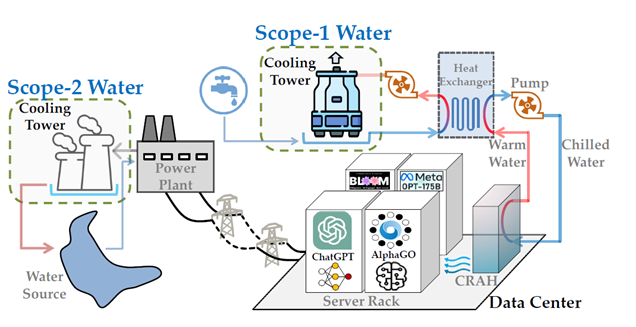
Photo: Operational water usage of AI in a data center (Source: Government of UK)
Beyond energy consumption, AI-driven data centers also have significant water and material footprints. Cooling systems rely heavily on water, with estimates suggesting that approximately two liters are required for every kilowatt-hour of electricity consumed. Globally, data centers used around 175 billion liters of water in 2023, a figure projected to more than triple to 664 billion liters by 2030, raising particular concerns in water-scarce regions. Broader estimates indicate total water consumption may be even higher when indirect use is included: the International Energy Agency estimates roughly 560 billion liters in 2023, with the majority linked to electricity generation rather than on-site cooling. According to the Government Digital Sustainability Alliance, the rapid expansion of AI is expected to drive a substantial increase in global water consumption, reaching as much as 6.6 billion cubic metres by 2027. At this level, AI-related water use would exceed half of the United Kingdom’s annual water consumption, highlighting the technology’s growing demand for natural resources. A further challenge is that much of the water used to cool data centers cannot be easily recycled. During the cooling process, water often evaporates or becomes contaminated with minerals, dust, and treatment chemicals, limiting its potential for reuse and increasing the demand for fresh water.
These impacts extend beyond operations. The production of AI hardware, especially GPUs, requires resource-intensive manufacturing processes, significant transport emissions, and raw material extraction that often involves environmentally harmful mining and toxic chemicals. Shipments of GPUs to data centers rose sharply from 2.67 million units in 2022 to 3.85 million in 2023, with further increases expected. At the same time, the rapid expansion of AI infrastructure is projected to generate up to 5 million tons of additional electronic waste by 2030. Taken together, AI’s environmental footprint goes well beyond electricity use, encompassing water consumption, resource extraction, and waste generation. These interconnected pressures are difficult to fully quantify due to limited corporate disclosure, but they underscore the broader ecological implications of scaling digital infrastructure.
Keeping AI Sustainable: The Policy Question
Despite growing recognition of AI’s environmental impacts, policy responses remain limited and uneven. More than 190 countries have adopted non-binding recommendations on the ethical use of AI, including environmental considerations. However, binding regulations are still relatively rare. Although regions such as the European Union and the United States have begun introducing measures to address these concerns, sustainability is often overlooked in national AI strategies, leaving a significant governance gap.

Photo: AI, environment and sustainability (Source: EnvironBuzz)
South Korea’s AI Basic Act, which took effect on January 22, 2026, illustrates this disconnect. As the world’s first comprehensive national AI framework, it governs development, deployment, and user protection through measures such as transparency requirements, prior notification for high-impact AI, and watermarking. However, it does not address environmental dimensions, such as energy use, grid impacts, water consumption, or emissions despite promoting AI infrastructure growth. This omission reflects a broader pattern, particularly in the United States, where AI governance is advancing faster than its integration with sustainability and energy systems. The United Nations Environment Programme identifies several priorities to address this challenge. These include establishing standardized methods to measure AI’s environmental footprint, improving transparency through mandatory disclosure of environmental impacts, and enhancing efficiency in AI systems to reduce energy and resource use. In addition, governments can encourage the development of greener data centers powered by renewable energy while integrating AI-related policies into broader environmental frameworks. Together, these steps are critical for aligning the rapid growth of AI with long-term sustainability goals.
AI Infrastructure, Sustainability, and Global Responsibility
Tech giants and executives defend AI’s resource-intensive infrastructure by arguing that many claims about excessive water use are exaggerated or based on outdated technologies. Sam Altman , CEO of OpenAI, defended the energy use of artificial intelligence by comparing it to the resources needed to educate and develop humans over many years. While he suggested that some concerns about AI’s power consumption may be exaggerated, he admitted that the technology’s growing energy demand is a real issue. Altman also emphasized the need to expand cleaner energy sources such as nuclear, wind, and solar power as debates over the environmental impact of AI data centers continue to grow.
While industry leaders often emphasize technological progress and downplay some environmental concerns surrounding AI infrastructure, growing international discussions increasingly highlight the broader sustainability challenges associated with AI expansion. In this context, António Guterres cautioned at the 2025 AI Summit in Paris, “The power of AI carries immense responsibilities,” even as those responsibilities remain concentrated in the hands of a few. However, these responsibilities extend beyond issues of AI governance, such as regulation, ethical oversight, transparency, and accountability. AI’s environmental footprint is multi-dimensional, affecting energy systems, water resources, and material supply chains. These pressures are interconnected and often difficult to fully quantify, particularly given limited transparency in corporate reporting. Nevertheless, current evidence makes clear that AI is not only a transformative technology but also a rapidly growing source of environmental strain. As deployment accelerates, addressing these challenges will require a more integrated approach that combines energy efficiency, sustainable resource management, and stronger regulatory oversight. Without such efforts, the environmental costs associated with AI risk undermining broader climate and sustainability objectives, raising critical questions about how to align technological progress with ecological limits.

- Beyond the Cloud: AI’s Energy Footprint and Environmental Cost - July 17, 2026
- Between Impunity and Silenced Voices: Gendered Violence in Bangladesh’s Hill Districts - March 31, 2026
- Integration, Not Assimilation: What South Korea Can Learn from Singapore - February 20, 2026