

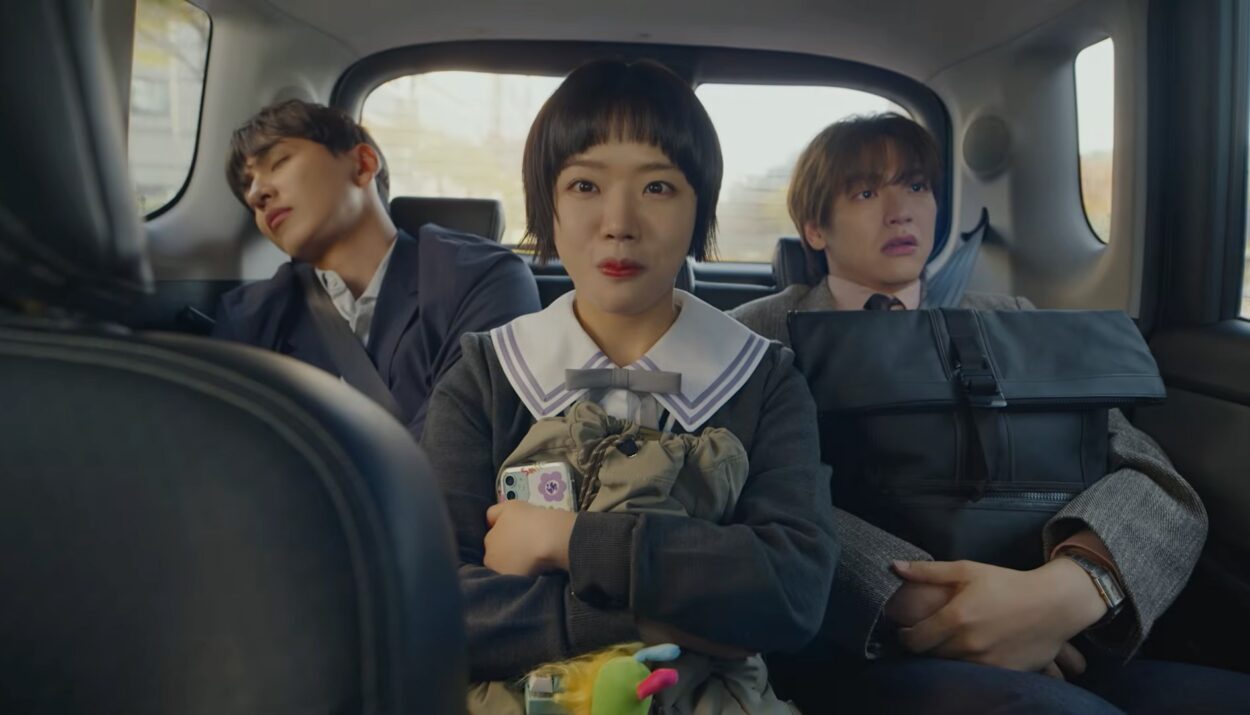
Defining the female gaze
Laura Mulvey put forth the concept of male gaze in 1975 with her essay, Visual Pleasure and Narrative Cinema, where she explained women’s voyeuristic portrayal in cinema—a sexualization of the woman for the heterosexual male viewer. As means of production in the media landscape remain controlled by men, cinema remains fixated on showing women for the ‘male gaze.’
What constitutes the female gaze then? There are two perspectives on this matter. The first one mandates the involvement of women in the cinematic piece through either writing, direction, or production. It also requires the works to give agency to their female characters. The loophole—it only tackles the creation of the work and not the reception.
The second perspective states that the female viewer’s gaze is fixated on the male character in the work. However, some arguments refute this definition by claiming that women do not engage in active objectification of men on screen. A further argument in this perspective is that the female gaze is on all characters, irrespective of gender.
As the female gaze did not emerge as an independent concept but was made to both parallel and contrast the male gaze, any definition would appear insufficient in a standalone manner.
Female gaze and Korean dramas
Korean dramas have succeeded in catering to the female gaze from both perspectives—women forming a core of production teams and female characters being given agency. Along with that, the depiction of men on screen—irrespective of genre—has been for women to ‘look’ at them.
Although discussions about the female gaze in Korean dramas have gained momentum only recently, its origins can be traced back to the early 2000s. Actor Bae Yong-joon’s iconic role as Kang Joon-sang/ Lee Min-hyung in Winter Sonata(2002) made him a superstar in Japan and earned him the title of ‘Yonsama’. Academic and writer Sun Jung calls this Yonsama Syndrome a pivotal moment which created a new era of the Hallyu wave in Japan, making Bae Yong-joon an icon of “transnational cultural flows.”
Perhaps the most significant aspect of Bae Yong-joon’s fandom wave in Japan was his fans, who were mostly middle-aged women. This wasn’t just about Bae Yong-joon’s looks but the masculinity he portrayed—soft masculinity.
A manifestation of soft masculinity, kkonminam (flower boys) is one of South Korea’s biggest cultural exports. At a time when most of Western cinema was focused on hypermasculine images who had to ‘obtain’ women, Korean dramas’ soft masculinity put forth an alternative narrative, one that involved pursuit but also consent and space. Seldom did anyone see male characters in Korean dramas objectifying women.
The female viewers’ gaze was thus directed at 1) on-screen men who treated women right and 2) women whose non-sexualized depiction made them real and allowed identification. Considering that most dramas had some level of romance—of which most was heterosexual—and the primary audiences were cis-hetero women, male leads became objects of desire for their personalities and not their bodies.
This trend continues to the present day and is now discussed more due to the deliberate design of male characters for the female gaze.
The “amorality” of gaze
To say that the female gaze only takes into account good behavior would be an oversimplification. The female gaze, when ‘looking’ at men, engages in some form of objectification, which stems from desire.
Amorality doesn’t see right or wrong, and nor does gaze. The female gaze doesn’t just see a character’s morality but also the aesthetic. Simply put, a hot villain would be admired as much as a green flag hero.
The design of the protagonist and antagonist then is to exclusively capture the female gaze through aesthetics. The villain, then, if aesthetically pleasing, becomes a gray character, and since not absolutely evil, gets some level of sympathy.
The justification of evil acts, too, has an underlying gaze. For instance, in Mercy For None, Lee Geum-son (Choo Young-woo) and Gu Jun-mo (Gong Myung) were hot villains who had female viewers enraptured. In contrast, their fathers— Lee Woo-jun (Huh Joon-ho) and Gu Bong-san (Ahn Kil-kang)—equal villains, weren’t spared. It shows that a villain in his 60s does not have the aesthetics for justifying his behavior the way one in his 20s or 30s does. The show becomes a classic example of both the amorality of gaze and the aesthetics associated with it.
The list continues with Ryu Shi-oh (Byeon Woo-seok) in Strong Girl Namsoon and Jang Geun-won (Ahn Bo-hyun) in Itaewon Class—villains who had a fandom. What might also stand out in Korean drama villains is the exercise of restraint. In Strong Girl Namsoon, although Shi-oh likes Nam-soon (Lee Yoo-mi), he neither forces her to like him nor does he harm her upon discovering her betrayal.
Perhaps this tenderness and restraint are what make villains objects of the gaze too. They are seen as humans who have their moments of doing and being good, even in their moral greyness.
The duality (or continuity) of the female gaze—
The complexity of the female gaze can also be understood through the levels at which it operates. When a female character looks at the male character within the show, it becomes the first gaze of admiration. This first gaze within the screen guides the gaze of the female viewer outside, which then becomes a derived or second gaze.
However, for most part, the female viewers would experience the first gaze outside the screen.
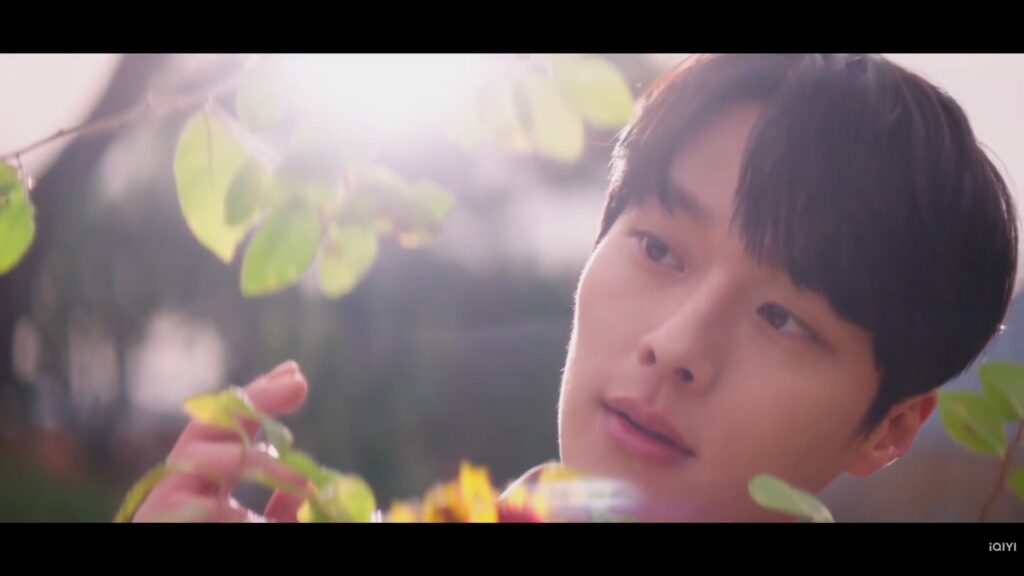

Stills from My Roommate is a Gumiho Episode 5. Source: Youtube- iQiyi
This scene from My Roommate is a Gumiho explains how the female gaze operates within the screen. The way Lee Dam (Hyeri) looks at Shin Woo-yeo (Jang Ki-yong) is not mere admiration but a gaze which signals attraction. The audiences are expected to unite their gaze with Dam since there is no other lens available. Dam’s gaze is no longer limited to within the screen but continues outside.
Korean drama bromances also serve the female gaze through men’s physical closeness. It can be attributed to the popularity of the Boys’ Love genre. While mainstream dramas do not depict homosexuality explicitly, they use it as a humor trope.
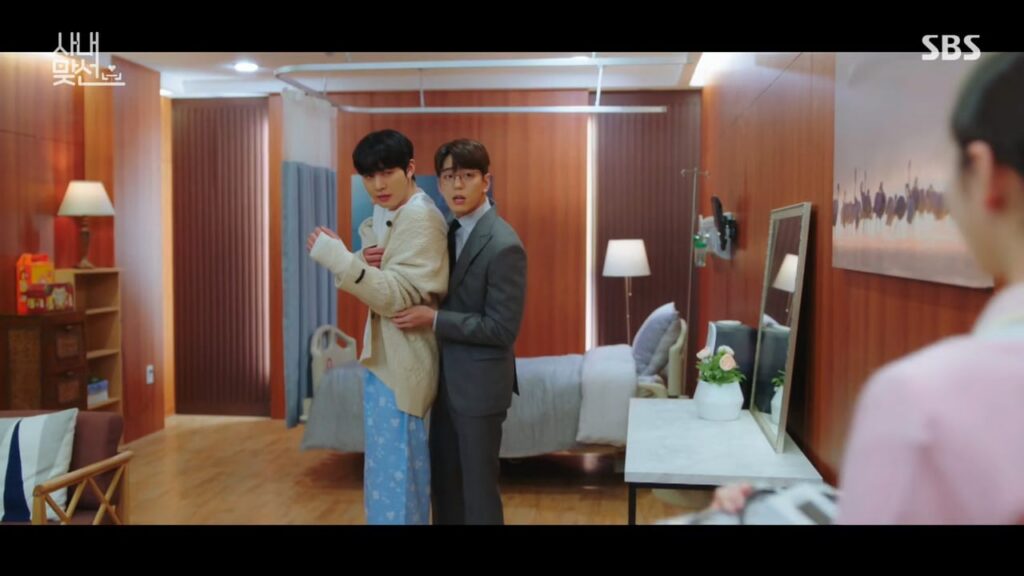
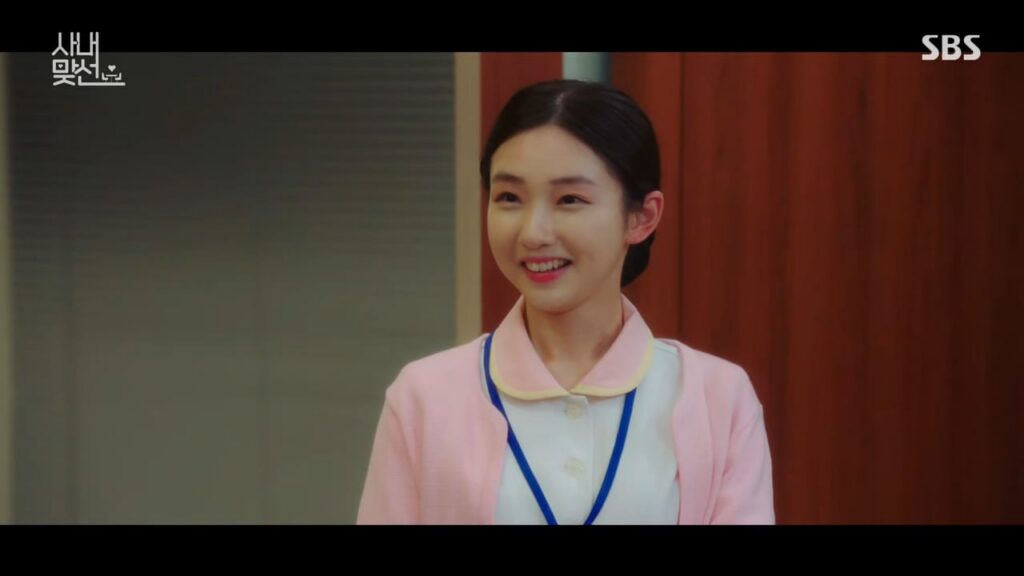
Stills from Business Proposal Episode 11. Source: Netflix
These two popular hospital scenes (a coincidence it might be) elicit two completely different reactions from the women on the screen who witness them.
In True Beauty, Lee Su-ho (Cha Eun-woo) and Han Seo-jun (Hwang In-youp) form a love triangle with Im Ju-kyung (Mun Ka-young). When Ju-kyung’s love interest is at stake (here, Lee Su-ho), the shocked reaction is rather obvious. Anyone who knows the fan wars that happened between Team Su-ho and Team Seo-jun while True Beauty aired would know that Ju-kyung’s gaze would be hers alone. Even when continued outside the screen, the gaze would elicit a different reaction from the viewers, who would take into account the behavior and aesthetics of the male leads and prefer their closeness over competition.
In Business Proposal, however, Kang Tae-mu (Ahn Hyo-seop) and Cha Sung-hoon (Kim Min-gyu) were not spotted by a female lead but by a nurse. There was no competition between them in the storyline, and Tae-mu and Sung-hoon’s proximity was an added offering to the audience. The audience shared the nurse’s gaze—one filled with admiration and acceptance. The attempt at justification from the male leads’ end was irrelevant to both the nurse and the female viewers outside.
What’s important here is that the gaze is no longer about erotic desires but about a fantasy which blends into queerbaiting the characters.
Fan participation-
Fan participation and interaction on both offline and online fronts have caused a significant shift in the way male characters are depicted. In Celebrity Bromances, Lam and Raphael call celebrity figures a part of the market economy. Korean celebrities, through their characters and resulting character perceptions, are marketed as products whose end point of consumption is the female viewer.
Gu Jun-pyo’s (Lee Min-ho) pursuit of Geum Jan-di (Koo Hye-sun) in the hit Boys Over Flowers, was once revered but is now questioned. In retrospection, fans are calling F4 toxic. In contrast, Yang Gwan-shik (Park Bo-gum) from When Life Gives You Tangerines has become the epitome of a green flag for his gentleness and his ability to stand up for his wife, a rare tendency. From 2009 to 2026, the female gaze has evolved—it does not seek superficiality and material wealth but enduring genuineness.
The gaze also looks for deeper layers of meaning through gestures and actions which stem from concern and not desire. A latest example would be Dynamite Kiss where Go Da-rim (Ahn Eun-jin) is told by her mother to focus on acts of love and care instead of mere words. This itself reflects what women seek on screen and in real life.
Fan participation and perception has also impacted the way women are depicted in shows. No longer do we see a poor helpless female lead—or worse a stupid one—who needs to be saved. Female characters possess their own agency, and make their own decisions- something that can also be attributed to major writers being women. Female viewers too, are no longer passive recipients of what is given to them. They actively generate meaning themselves and set the tone for the content they are willing to consume.
Although the male lead is designed to suit the female gaze, the depiction is always romanticized, since reality does not sell as much as idealism does. In Intimacy Beyond Sex, Min Joo Lee dishes out about the impact of Korean dramas on foreign women visiting Korea and their belief in a purported nonsexuality of Korean men. The infamous ‘Hongdae guy’ with his “Are you open-minded?” suggests quite the opposite. South Korea’s 4B movement brings to light a reality that dramas ignore. And yet, it is noteworthy to see how dramas shape perceptions, even though they bear little to no verisimilitude to reality.
The female gaze is often misconstrued to be a feminist endeavor and thus subject to criticism. Yet, the truth lies in the fact that entertainment industries boom because women watch. And because women gaze.
Written by: Roshni Chauhan

Do you want to become a contributing writer to NOVAsia? Send us an email at novasiamag@gmail.com
- Korean Drama Male Leads and the Female Gaze - June 14, 2026
- In the Age of AI: Deepfake Crisis in South Korea - May 26, 2026
- From Underground to Mainstream: The Legal Rise of Tattoos in South Korea - March 13, 2026