

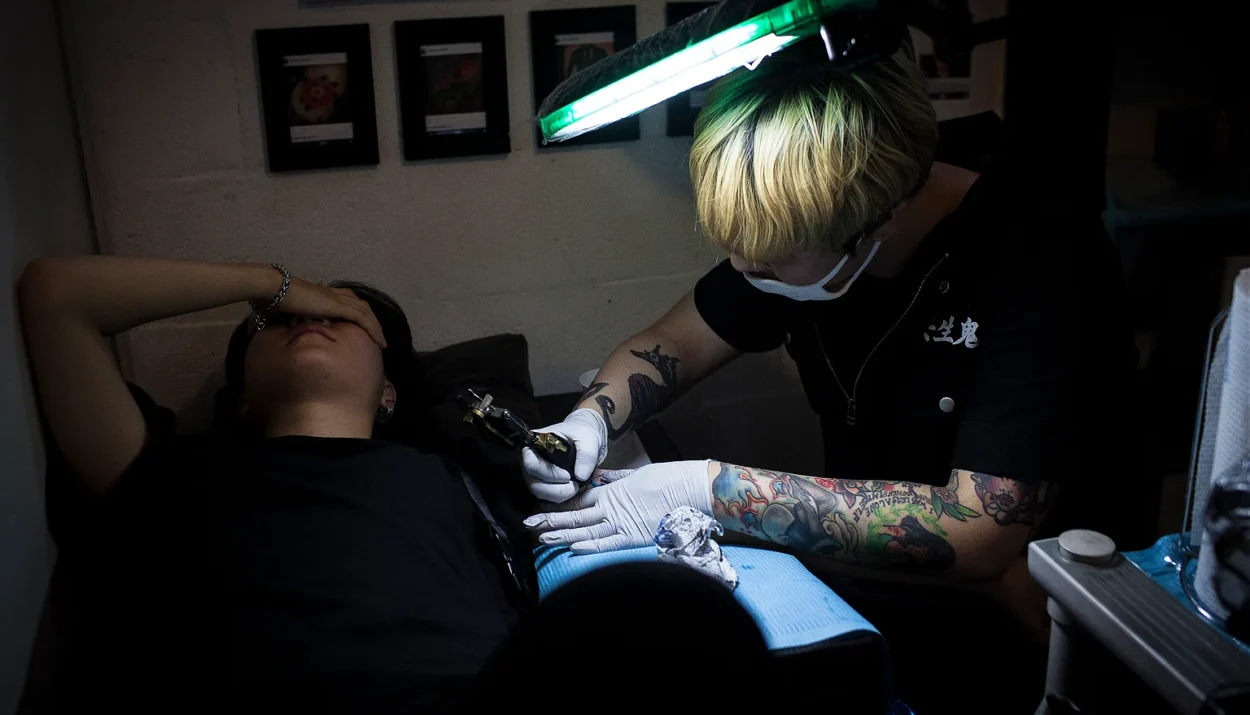
Despite a rapid rise to prominence as a global fashion city and hub for contemporary street style, Seoul’s streets tell a story of contrast. Beneath this bold surface of global recognition lies a quiet rebellion: the art of tattooing. For years, tattoo artists in South Korea have been practicing their craft in underground spaces, behind unmarked studio doors. Since the law in 1992 under the Medical Services Act was enacted, it explicitly forbade those without a medical license from performing tattoos.
Many trace the roots of this bias back to Confucianism, the ancient Chinese philosophy that shaped Korea’s moral and social order. At its heart lies the principle of filial piety—the idea that one must honor one’s parents through obedience and respect. Within this worldview, the body is considered a sacred gift from one’s parents, and altering or marking it is seen as a disregard for that gift. Thus, tattoos became more than an act of personal choice; they were seen as a symbolic break from familial and social duty—a defiance of tradition itself.
In 2025, as South Korea continues to redefine its cultural identity, the government has taken a decisive step toward change. Under the new administration, parliament has passed a landmark bill that will finally legalize professional tattoo artists—ending the decades-long rule that restricted tattooing to licensed medical practitioners only. This new law, when it comes into effect, will open the door for an art form once relegated to underground studios and will emerge into public life.
Historical Implications of Tattoos in Korea
During the Goryeo and Joseon reigns, tattooing was used as a form of punishment for criminals. They were branded with ink to signify their crimes or to show loyalty to the respective royal regime. Individuals convicted of robbery who did not receive a death sentence had the word “robber” carved into their bodies. It’s no surprise that tattoos came to be seen as associated with crime rather than recognized as a cultural expression.
That perception deepened in the 20th century, when modern tattoo culture in Korea became linked to Japanese yakuza gangs, well known for their heavily tattooed bodies. Koreans started imitating the yakuza and joined organized crime networks and worked together. It became customary for gang members to get matching tattoos as a symbol of bond and allegiance. Gradually, the image of the tattooed body grew to be associated with danger, rebellion, and the underworld, further distancing tattoos from general acceptance.
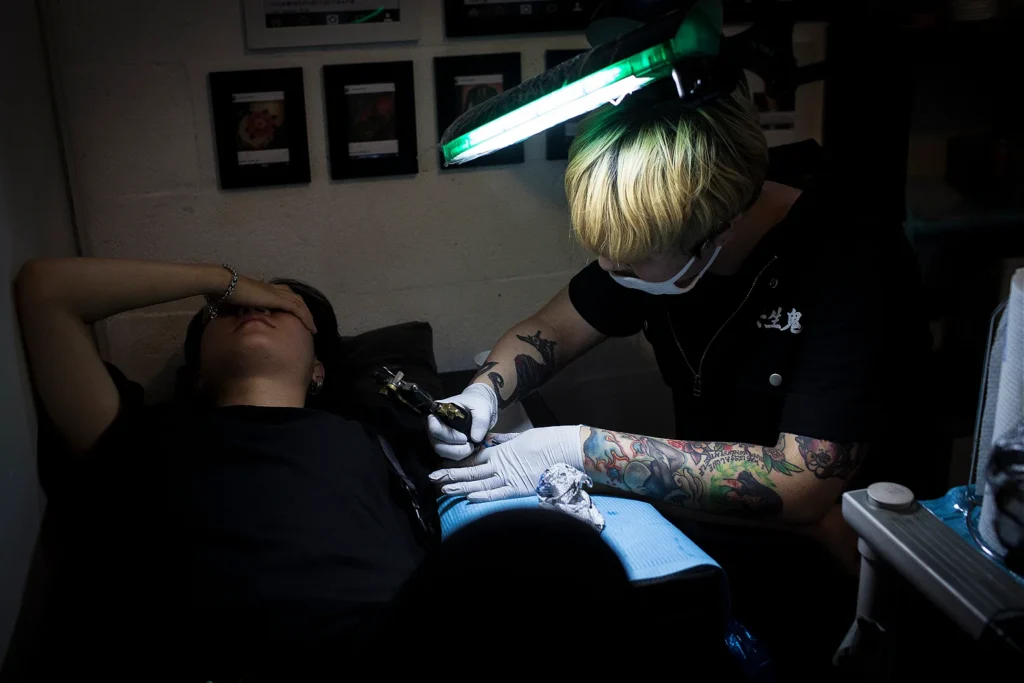 A woman gets her first tattoo (Source: Guillem Sartorio Teixidó)
The 1992 Verdict
The legal limitations surrounding tattooing date back to 1992, when the Supreme Court of South Korea ruled the practice as a medical procedure. Under the Medical Services Act, tattooing is classified as a procedure that requires sterilization and health-related precautions—a condition only licensed doctors are authorized to perform. This ruling effectively criminalized the work of independent tattoo artists, leading them to face up to five years in prison and a fine of up to 50 million won ($35,740) if caught. The decision was not made in isolation; it was driven by deeply ingrained cultural associations between tattoos and criminality. The 1992 ruling reinforced this legacy, portraying tattooing as illegal and offensive. As a result, many tattoo artists were compelled to go underground, working discreetly without studio signs and constantly facing punishment and persecution. Some even fled the nation entirely, hoping to practice their profession without fear of penalties.
The Modern Shift in Tattoo Culture
By the 2010s, there had been a significant generational shift in attitudes towards tattoos throughout Asia and most of the world. In South Korea, the growing popularity of cosmetic tattoos among older women, such as eyebrow tattoos and permanent cosmetics, has played an important role in normalizing tattooing in general. Practices that were once stigmatized have gradually become accepted as everyday aspects of beauty and self-care. This transition was further supported by the advent of social media platforms such as Instagram and YouTube, which allowed tattoo artists to showcase their work and users to publicly share their tattoos, increasing visibility and reframing tattooing as a valid cultural and creative endeavor. A 2021 Gallup poll found that 81% of South Koreans in their 20s and 60% in their 30s and 40s are in favor of lifting tattoo restrictions.
Despite this widespread acceptance, a growing trend involving the banning of tattoo display still emerges. Notice boardsoutside gyms, bars, and other public places can be seen preventing people with certain tattoo sizes from entering or requiring them to cover such tattoos with long sleeves and pants. Prominent media companies like KBS, SBS, and MBC maintain a policy of prohibiting the display of tattoos, often requiring K-pop artists with tattoos to conceal them before recording sessions. They either cover it with makeup or tape it, and sometimes they simply blur it during editing.
 Block B’s Taeil in oversized sweaters and covering his tattoos with tape (Source: Inked)
Although no legal framework officially demands these actions, media companies justify such safeguards by expressing concerns over potential negative influence on younger audiences. This difference in growing social attitudes and established media self-regulation indicates the uneven pace at which tattoo acceptability has grown in South Korea.
The Rise of Tattoo Legality
Following campaigns around the country by tattoo artists to practice without fear of harassment or prosecution, South Korea on September 25, 2025, legalized tattoo artistry by non-medical practitioners for the first time in 33 years by implementing the “tattooist law”. This new law will formally take effect 2 years after promulgation, but temporary registration to carry out tattooing will be allowed till then.
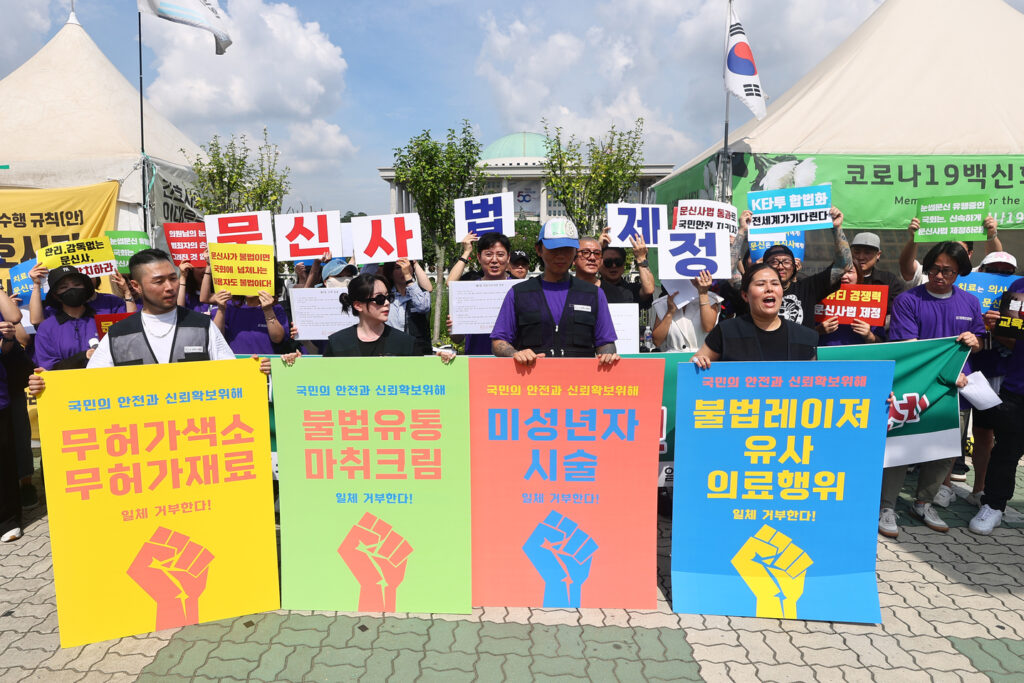 A group of tattoo artists stage a protest calling for legislation of a bill that acknowledges tattooists as a legitimate occupation in front of the National Assembly in western Seoul (Source: koreajoongangdaily)
However, tattoo removal is still legally banned. Tattooing minors without parental consent is also forbidden, and all tattooists must complete mandatory hygiene and safety training. Tattooists are also required to record and retain details such as the date, dye type, amount used, and the body area worked on.
Conversation with a Tattoo artist
To understand what this change means for those at the heart of it, I spoke with Charon, a tattoo artist from Ilsan who works at Gravitate Studio. “Charon” isn’t his real name but a pseudonym—a common precaution among tattoo artists wary of using their real names.
“It feels like I’ve finally come back to where I belong,” he told me when I asked about the legalization. His words carried a mix of relief and hope. “I hope we see a shift in how tattoos are perceived, improved schemes for artists, and diverse opportunities—the kind of life tattoo artists take for granted in other countries. Korean tattoo artists have always had to consider going overseas, but I hope everything can finally normalize now.”
Charon’s longing to belong in his own country reflects a larger tension within South Korea’s evolving tattoo culture: the struggle between creative freedom and social stigma. “I’ve been asked several times by colleagues to go abroad,” he admitted, “but I love life in Korea and want to do tattooing in this country. I hope tattooing gains recognition as art here. All I want is to live happily doing what I love the most – and that’s something I can’t find anywhere else.”
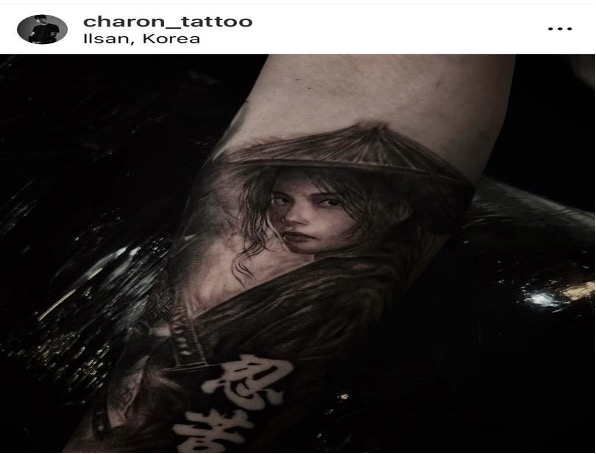 Tattoo by Charon (Source: Instagram)
Like many in his field, Charon’s journey into tattooing began with a love for drawing. After starting his career as a designer, he discovered tattooing as a new medium of artistic expression. Today, his work—rich with Gothic and mythological influences—draws heavily on classical art. “Classical art is inherently beautiful,” he explained. “It embodies intuitive beauty—it allows anyone to perceive beauty without needing interpretation. Charon’s perspective reflects the combination of art, identity, and belonging that defines South Korea’s shifting tattoo culture. For generations, tattooing was an underground act—an expression of rebellion as much as creativity. Now, as the legal and cultural forces begin to shift, artists like Charon find themselves on the verge of a new era—one in which their work may finally be viewed as art rather than defiance.
Diksha Kashyap is a NOVAsia Contributor whose research interests are related to Contemporary Korea’s social and cultural history.

Do you want to become a contributing writer to NOVAsia? Send us an email at novasiamag@gmail.com
- Korean Drama Male Leads and the Female Gaze - June 14, 2026
- In the Age of AI: Deepfake Crisis in South Korea - May 26, 2026
- From Underground to Mainstream: The Legal Rise of Tattoos in South Korea - March 13, 2026