
Clashes in the Chittagong Hill Tracts (CHT) of Bangladesh killed at least three people and injured dozens after the reported gang rape of an eighth-grade indigenous girl in Khagrachhari in September 2025. She was found unconscious after the alleged assault, and police have arrested a Bengali teenager who is now on a six-day remand. According to Amnesty International, the incident fits a longstanding pattern of violence and accompanying weak institutional response in the Hill Tracts, where eleven indigenous communities of the country reside. Over the decades, the conflict in Chittagong Hill Tracts (CHT) has generated extensive violence, human rights violations, and large-scale displacement, resulting in tens of thousands of deaths and hundreds of thousands becoming refugees. Despite various peace accords, the conflict remains unresolved, and the indigenous communities continue to fight for their rights and greater autonomy, while Indigenous women in particular face ongoing gender-based violence compounded by legal and structural obstacles to justice.
Historical Context of the Chittagong Hill Tracts Conflict
The Chittagong Hill Tracts (CHT) in southeastern Bangladesh, bordering India and Myanmar, constitute the ancestral homeland of the Jumma people—an umbrella term for several indigenous (আদিবাসী – adibasi) communities such as the Chakma, Marma, Tripuri, Tanchangya, Mru, Bawm, Lushai, and others. Long-standing tensions in the region stem from a series of historical developments, beginning with British administration in the 19th century, followed by the 1947 partition and the region’s incorporation into East Pakistan, now Bangladesh. The construction of the Kaptai Dam in the 1960s uprooted thousands of Jumma residents and severely undermined their traditional livelihoods. Following the 1971 Liberation War, the constitution of the newly founded country did not formally recognize the distinct ethnic identities or cultural practices of these communities. In the following years, the government organized the relocation of roughly 300,000 Bengali settlers to the CHT, providing them with land, housing, and food support. This migration, concentrated between 1978 and 1990, nearly matched the region’s indigenous population of about 400,000, creating intense social and political strain.
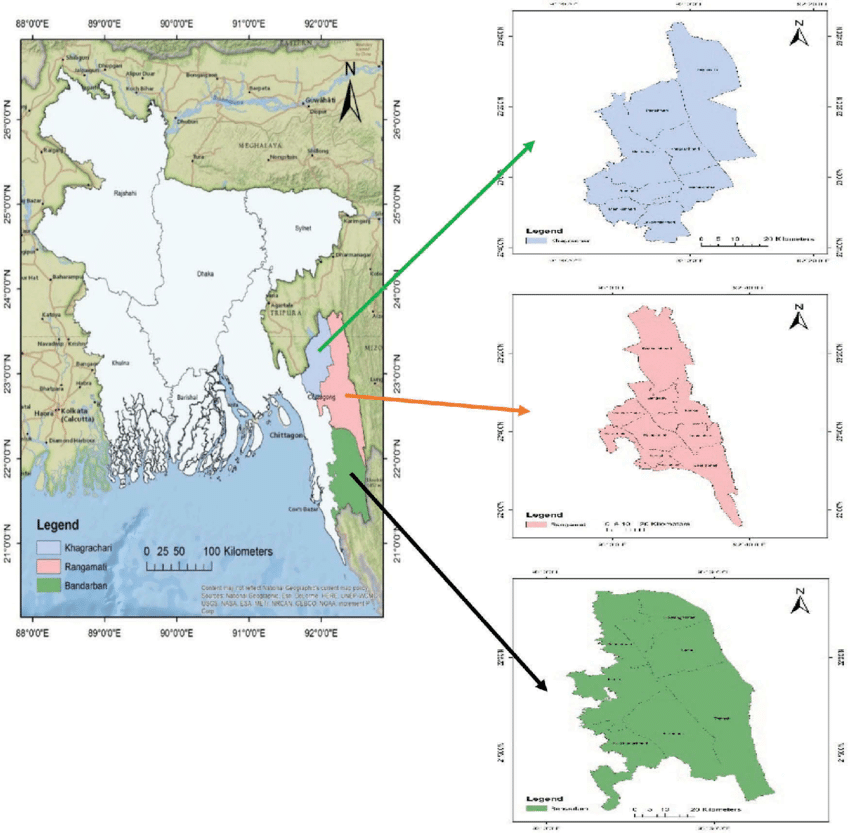
Photo: Map of Bangladesh demarcating CHT (Source: Mohammed Kamal Hossain)
The demographic profile of the region was transformed by these state-backed settlements, reducing the indigenous share of the population from around 98% in 1971 to about 50% by 2000. Jumma communities experienced various forms of state violence during this period, including pressure to abandon their religion, forced conversion of children, and widespread use of sexual violence by the military. Although the Chittagong Hill Tracts (CHT) conflict formally ended with the 1997 Peace Accord after 25 years of violence, the situation remains contentious. The oppression continues, as many of the Accord’s core provisions have not been carried out, reflecting either a lack of political will or the government’s inability to implement them. As the legacies of historical dispossession and state-backed settlements continue to reverberate, they also fuel the ongoing widespread targeting of indigenous women through sexual and gendered violence.
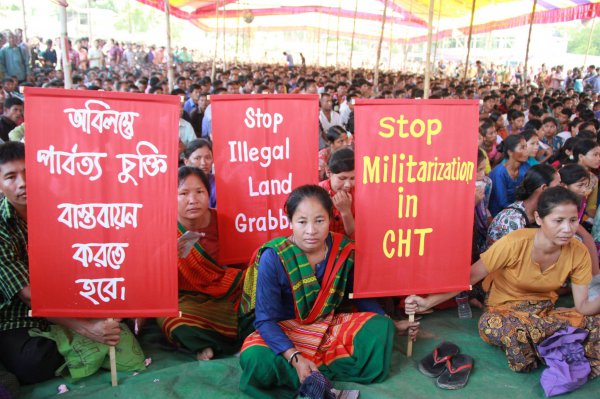
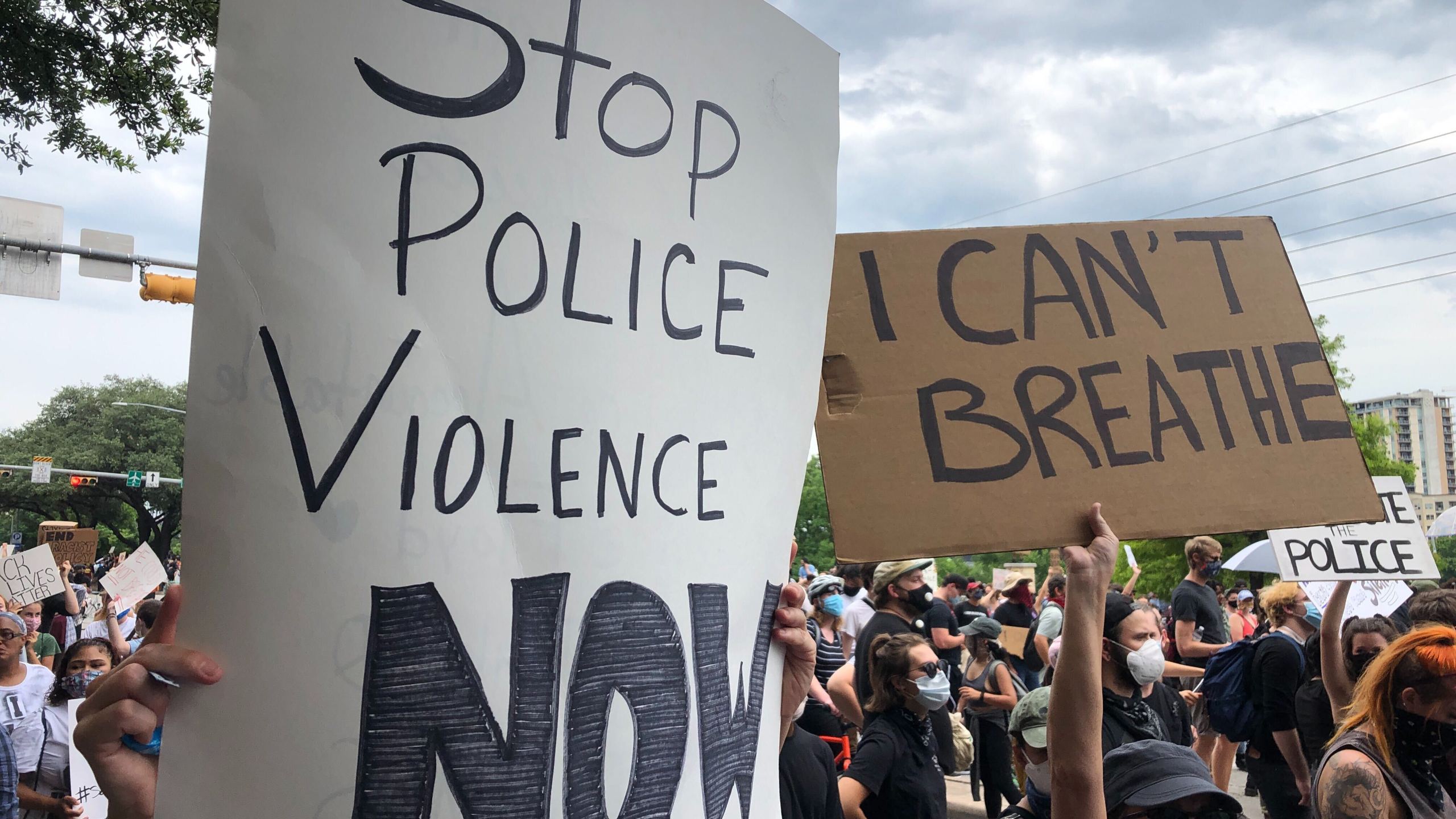
Photo: Protest by indigenous communities (Source: Land is Life)
Gendered Violence in Chittagong Hill Tracts
Rape, forced marriage, and other gendered abuses against indigenous women and girls remain pervasive in the CHT, sustained by the long-term impacts of earlier waves of violence. Periods of crisis at different times placed women and other marginalized groups at even greater risk. According to OHCHR, the abuses against female demonstrators were intentionally gendered, both in purpose and in execution. Assaults often focused on the face, chest, pelvis, and buttocks, while misogynistic slurs such as “whore” and “prostitute” are used, serving as tools of both physical harm and psychological degradation.
Violence against indigenous women in Chittagong Hill Tracts (CHT) goes beyond the actions of military personnel during the protests. In 2022, at least 19 rape cases of indigenous women and girls, including 7 gang rapes, were documented by Kapaeeng Foundation. The number of recorded cases of rape or attempted rape in 2020 was 25 in CHT, while many cases remained unreported. From January to June 2021, 37 indigenous women across Bangladesh experienced violence in 33 incidents, with nearly half occurring in the CHT. Rape and attempted rape were the most frequently reported crimes, yet 95% of survivors in the CHT feared social stigma, and 60% did not pursue legal assistance
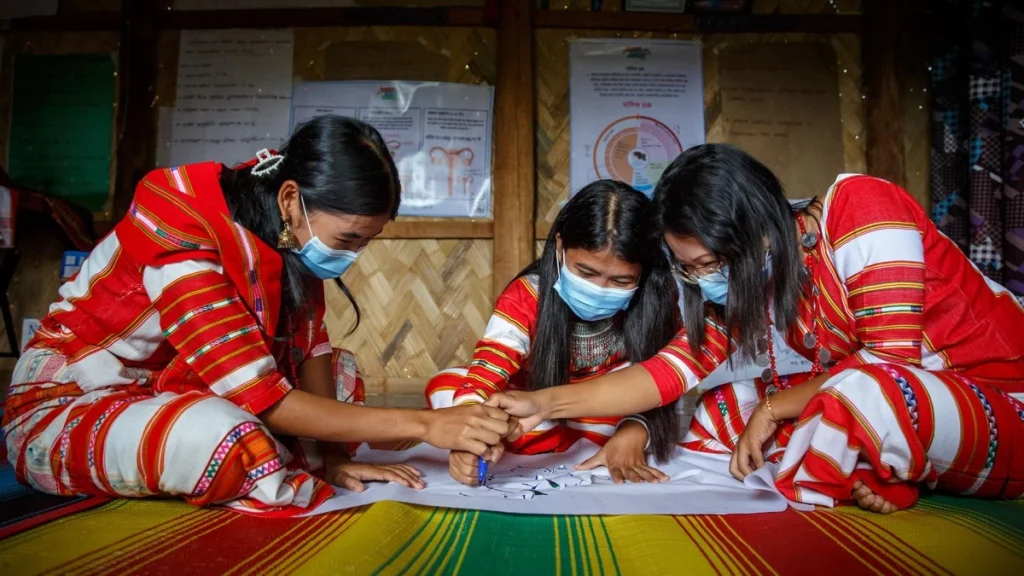
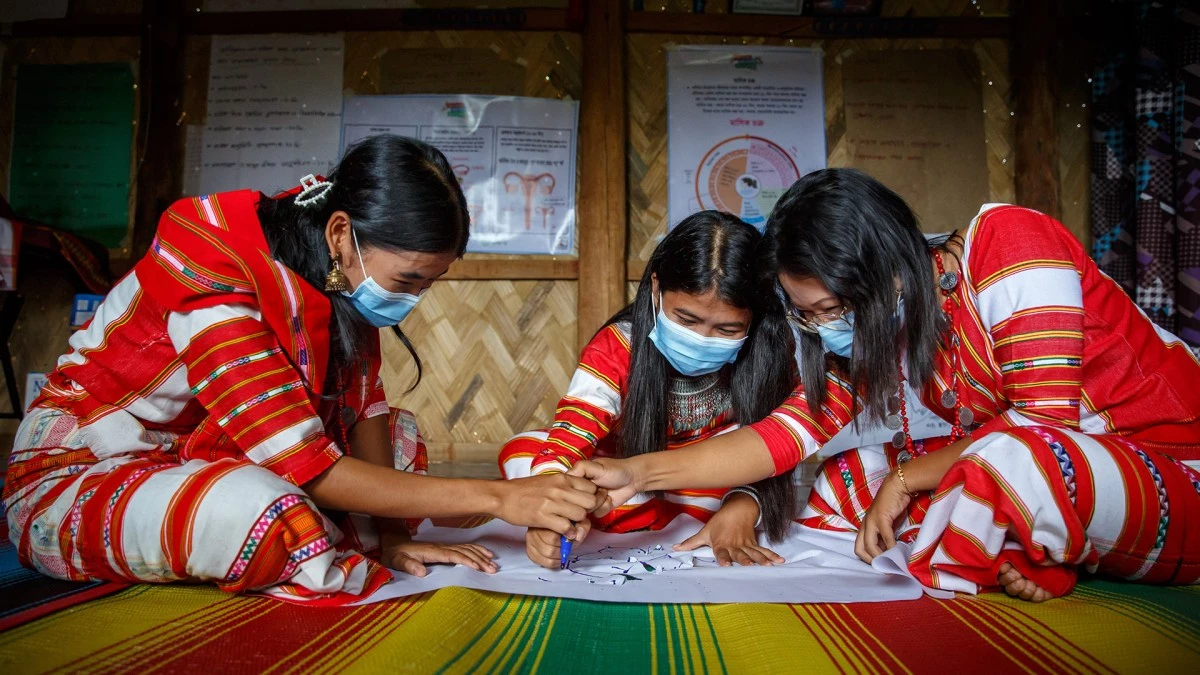
Photo: Indigenous girls at a learning space (Source: Simavi)
Exoticized Identities and the Burden of Stigma
Moreover, many settlers view indigenous women as exotic and fragile, leading indigenous women to alter their clothing – wearing longer garments and wrapping scarves to avoid unwanted attention. They regularly experience verbal and physical harassment, including frequent checks by military personnel on their way to the market. Chandra K. Roy, in her article “Indigenous Women: A Gender Perspective,” notes that indigenous women are targeted precisely because of their dual identity as both indigenous and female. She argues that rape has historically been used as a tool of domination, carrying symbolic meaning when directed at “enemy women,” particularly those of different ethnicities, religions, or political groups. This exoticization reduces indigenous women to a dehumanized, hyper-sexualized status. A striking example occurred in July, 2020, when a domestic help agency in Uttara, Dhaka distributed a flyer featuring an indigenous woman with the caption “Delivery within 24 hours, once booked,” effectively treating her like a commodity. According to Myat Moe Khaing, who is an indigenous woman herself, “As women, we are held as the visible expressions of culture. Our features are reduced to “exotic,” our skin “too bare.” Our cultural traditions are exoticized to create a stark difference against modern “Bangalee” culture. As life-givers, we are the backbone of our communities. Under the “separatist” label, we are painted as the “enemy” women. Our wombs are targeted to disrupt the transmission of indigenous ways of life. The violence is not just physical, it is deeply political and cultural.” This shows how exoticizing the identities of indigenous women has been leading to further marginalization and polarization, even in comparison to the male members of the indigenous communities, revealing the gendered side of the political oppression.
Barriers to Justice: Legal and Structural Obstacles
One question remains: what prevents women from reporting the violence they experience? The answer is rooted in longstanding systematic barriers. Many indigenous women and girls in remote areas often refrain from reporting violence due to limited medical and legal services. They face a justice system that ignores their languages and cultural norms, and discriminatory behaviors. One example can be the local authorities’ refusal to cooperate which intensifies these human rights abuses. The Chittagong Hill Tracts Commission, an advocacy NGO, notes that in cases involving rape allegations against settler men, medical staff often face pressure to downplay or omit evidence to avoid “heightening tensions.” The organization argues that deep-rooted impunity sustained by political, administrative, and judicial bias continues to deny indigenous communities’ equal access to justice and perpetuates gender-based violence.
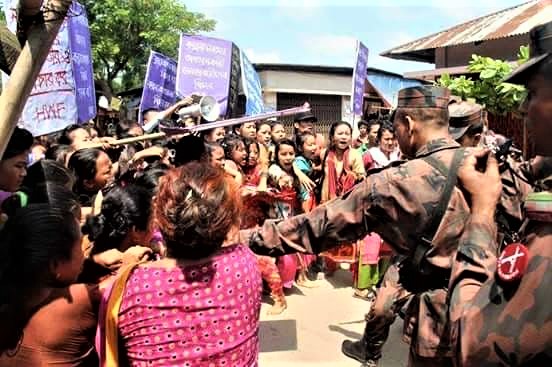
Photo: Security forces violently dispersing peaceful demonstrators (Source: APWLD)
Another systematic issue in this context is, convicted government officials are often transferred to CHT rather than being imposed with strict disciplinary measures. For example, in 2024, a teacher at Khagrachhari Government Technical School and College was accused of raping a seventh-grade Tripura student. Previously, he had been imprisoned for attempting to rape a student in Kushtia, after which he was relocated to Khagrachhari. This raises troubling concerns that the region is being used as a “dumping ground” for personnel with problematic histories, further undermining the safety and protection of indigenous women.
The ongoing violence against indigenous women in the Chittagong Hill Tracts, Bangladesh, reveals stories that are more than isolated incidents of abuse or personal tragedies. It exposes a persistent system of impunity and historical marginalization that intersects with gender, ethnicity, and social power. Despite formal peace accords and legal protections, indigenous women remain highly vulnerable, while perpetrators, from settlers to state officials, often evade accountability. These indigenous women bear the dual burden of being both culturally “othered” and systematically silenced. This ongoing cycle of abuse underscores the fragility of justice in the region and the enduring political and ethnic inequalities that perpetuate it. This puts forwards a question that has remained consistent throughout the decades: What will it take for the voices of indigenous women in the Hill Tracts to finally be heard?

- Beyond the Cloud: AI’s Energy Footprint and Environmental Cost - July 17, 2026
- Between Impunity and Silenced Voices: Gendered Violence in Bangladesh’s Hill Districts - March 31, 2026
- Integration, Not Assimilation: What South Korea Can Learn from Singapore - February 20, 2026